




Key Takeaways
- A sole trader operates individually with full control but full personal liability, while a partnership shares responsibilities without removing personal exposure.
- There is no single trigger point to move to a company – the decision depends on risk levels, growth plans and the number of people involved.
- Changing structure typically requires setting up a new entity and obtaining new registrations, rather than converting existing ones.

Table of Contents
- Sole Trader vs Partnership vs Company: When to Consider Moving to a Company
- Sole Trader vs Partnership: What's the Difference?
- How Businesses Typically Grow
- When Do Some Businesses Consider Moving to a Company?
- What Changes When You Move to a Company?
- Can I Change My ABN from Sole Trader to Partnership?
- How to Transition to a New Business Structure
- Ongoing Responsibilities to Keep in Mind
- Frequently Asked Questions
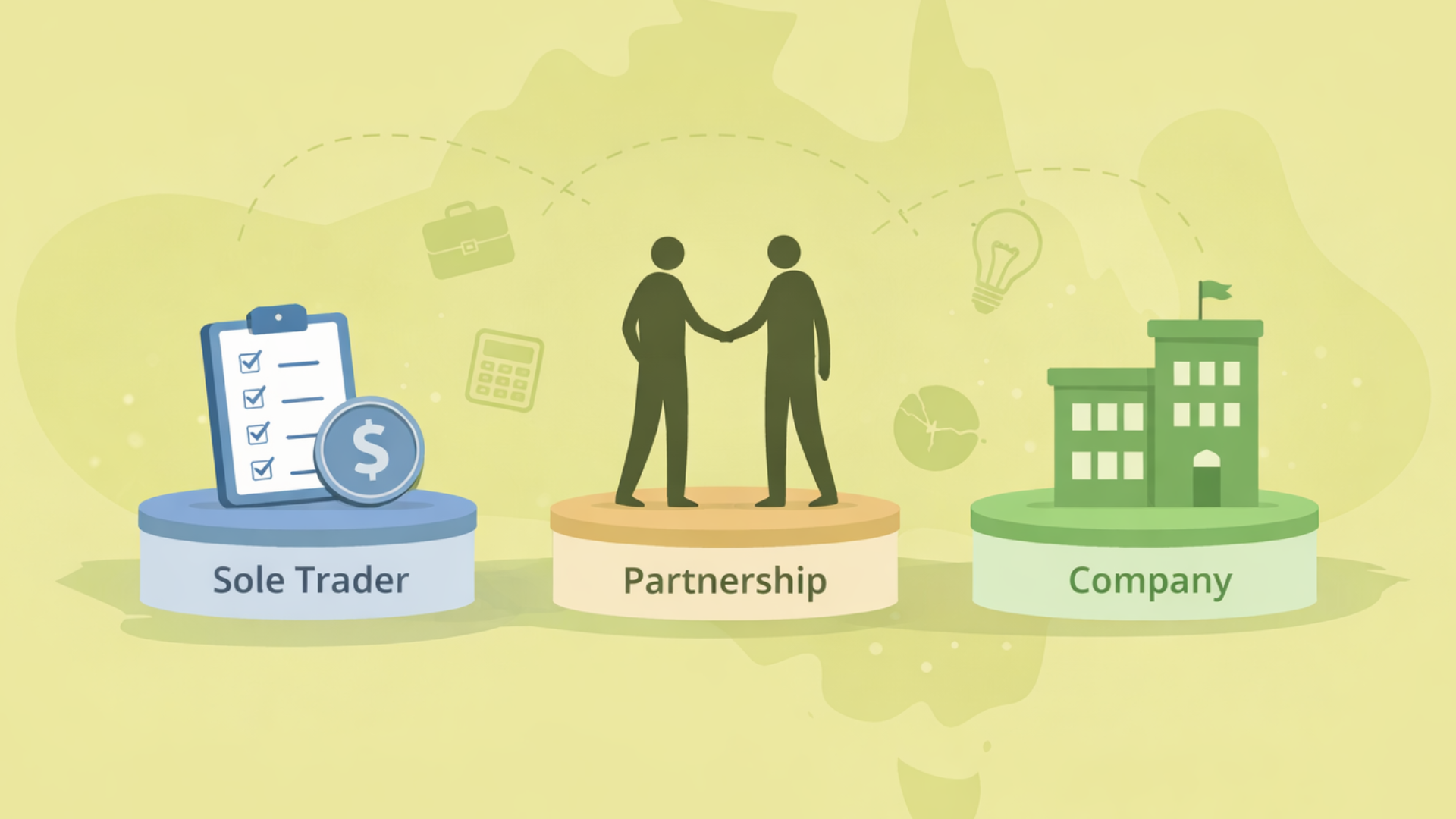
Sole Trader vs Partnership vs Company: When to Consider Moving to a Company
Many businesses in Australia start simple. A sole trader picks up a few clients, or two people team up and form a partnership. Over time, that small setup can grow into something more consistent, more complex and sometimes higher risk.
As your business evolves, it's natural to start thinking about whether your current structure still fits how you operate today. This guide explains the difference between sole trader and partnership structures and when some businesses begin to consider moving to a company.
Sole Trader vs Partnership: What's the Difference?
When comparing a sole trader vs partnership in Australia, the key differences come down to ownership, control and responsibility.
A sole trader operates the business as an individual. You have full control over decisions and keep all profits, but you are also personally responsible for the business, including its debts and obligations.
A partnership involves two or more people running a business together. Income, responsibilities and decisions are shared between partners. While responsibilities are shared, partners may still be personally liable for the actions of the business and, in some cases, each other.
Both structures are commonly used because they are relatively simple to set up and operate. In most cases, setting up either structure involves applying for an ABN, which you can complete through our ABN Registration in just a few steps.
However, as a business grows, the way risk, income and responsibilities are managed can become more important.
How Businesses Typically Grow
Most businesses don't start with a complex structure. A tradie might begin as a sole trader, taking on small jobs. Over time, demand increases, work becomes more consistent and income grows.
At some point, they may bring in another person to help, which can lead to a partnership. As operations expand further, the business may take on larger jobs, hire staff or manage more financial commitments.
As this happens, the structure that once worked well may no longer reflect how the business operates. This is often when business owners start exploring whether a different structure, such as a company, may be more suitable.
When Do Some Businesses Consider Moving to a Company?
There is no single point where a business must switch to a company. The decision depends on how the business operates and what the owners are trying to achieve.
Some businesses choose to move to a company structure as their operations grow or become more complex. If you'd like to understand how this works and what's involved, you can read more about Company Registration and how the process is typically completed.
Some common indicators include:
- When business activities involve higher levels of financial or operational risk
- When there are multiple people involved in decision-making or ownership
- When the business is hiring employees or managing ongoing staff
- When the structure needs to better support growth or long-term plans
- When there is a desire to separate personal and business matters
These are general indicators rather than rules. Different businesses may make this decision at different stages.
What Changes When You Move to a Company?
A company is a separate legal entity registered with ASIC. This means the business operates in its own name, rather than as an individual or group of individuals.
Because of this, a company can enter into contracts, hold assets and take on obligations independently. This structure is different from sole traders and partnerships, where the individuals and the business are more closely linked.
With this separation comes additional responsibilities. Companies are required to meet ongoing obligations such as maintaining company details, completing annual reviews and keeping appropriate records.
If you're exploring this option, you can learn more about how it works through our Company Registration page, which outlines the process and what's involved.
Can I Change My ABN from Sole Trader to Partnership?
Business structures are not fixed and it's common for businesses to change structure as they grow or their circumstances change.
However, it's important to understand that an ABN is linked to a specific structure. This means you generally don't "convert" an ABN from one structure to another. Instead, a new structure is set up and new or updated registrations are completed.
For example:
- Moving from sole trader to partnership usually involves setting up a new partnership ABN
- Moving to a company involves registering the company and obtaining a new ABN for that company
Because of this, changes are usually handled as a new setup rather than a direct switch.
How to Transition to a New Business Structure
Changing your business structure doesn't need to disrupt your operations if it's done in a structured way.
A typical transition may involve:
- Registering the new business structure (such as a partnership or company)
- Applying for the relevant ABN and tax registrations for that structure
- Updating business details such as bank accounts, invoices and contracts
- Notifying clients, suppliers and stakeholders of the change
- Reviewing insurance and other operational requirements
The exact steps can vary depending on your situation, but the goal is to ensure your new structure is set up correctly before transitioning fully.
Ongoing Responsibilities to Keep in Mind
Each business structure comes with its own responsibilities. Sole traders and partnerships generally have fewer ongoing requirements, while companies have additional compliance obligations.
For companies, this can include maintaining up-to-date records, meeting ASIC requirements and completing annual reviews.
Some business owners choose to manage this themselves, while others use services like Honcho's Company Compliance to help stay on top of these requirements in a more streamlined way.
Frequently Asked Questions
Is a partnership better than a sole trader?
Neither structure is inherently better. A sole trader setup offers simplicity and full control, while a partnership allows responsibilities and workload to be shared. The right option depends on how you plan to operate.
If you're unsure, you can explore your options using our Business Wizard, which helps guide you based on your setup.
When should I move from sole trader or partnership to a company?
There isn't a fixed point where this applies. Some businesses consider a company structure as they grow, take on more risk or involve more people. It depends on how your business operates and what you're aiming to achieve.
If you'd like to understand how this works, you can read more on our Company Registration page.
Can I use the same ABN if I change structure?
In most cases, no. An ABN is linked to a specific business structure, so changing structure usually involves applying for a new ABN for the new entity.
You can complete a new ABN Registration online once your new structure is set up.
Do I need to register for GST when moving to a company?
GST requirements are based on turnover rather than structure. Businesses generally need to register for GST when their annual turnover reaches $75,000 or more, regardless of whether they are a sole trader, partnership or company.
If required, you can complete your GST Registration as part of your business setup.
Can I register everything myself?
Yes. You can register a business directly with government systems such as the ABR and ASIC. Alternatively, some people choose to use a managed service like Honcho, where the process is guided, simplified and submitted in real time through official systems.
You can get started with your ABN Registration, Business Name Registration or Company Registration online, depending on your setup.

Miralda Ishkhanian

Chief Operating Officer





 1300 587 203
 support@honcho.com
 Monday - Friday 9AM - 8PM AEST
 Suite 703, Level 7 The Trust Building 155 King Street, Sydney NSW 2000